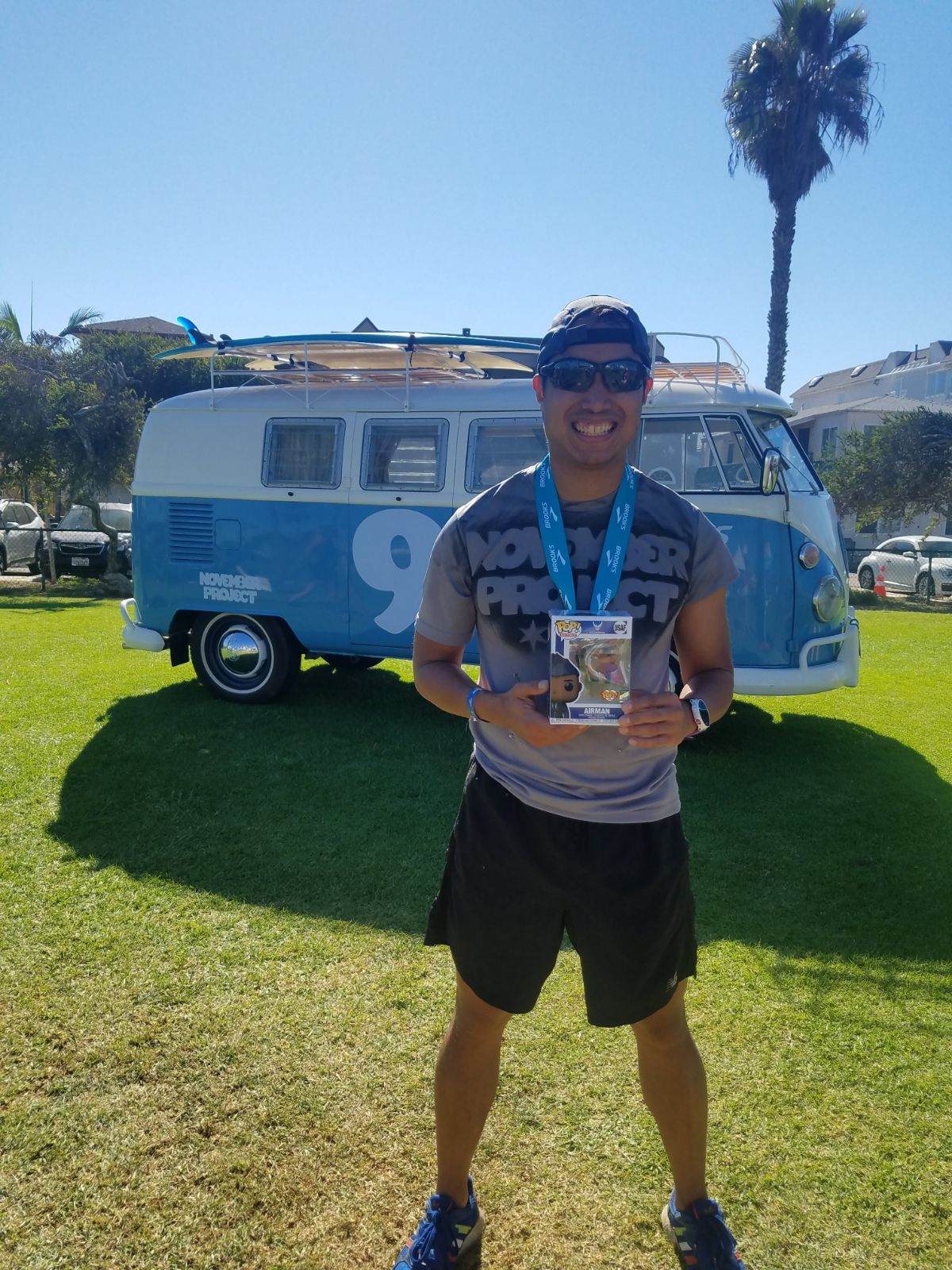
Today, we continue our celebration of AANHPI month with Vince (he/him), current Co-leader in NP Chicago. As new Co-leader, Vince is just getting his feet wet when it comes to leading a group but he grounds himself in his heritage and trusting his community.
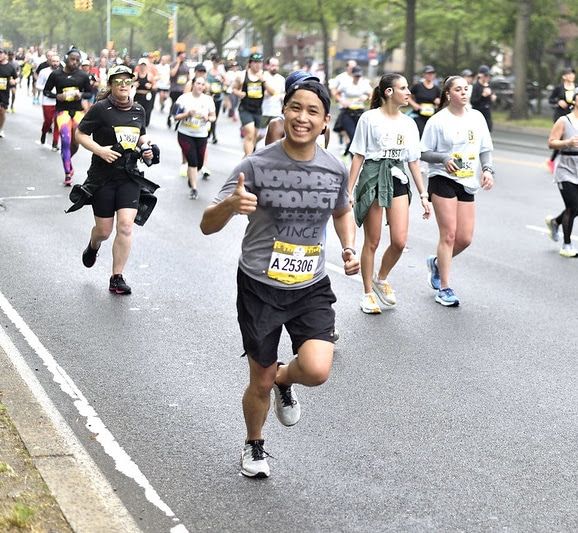
What words do you use to describe your full identity/all your identities?
Filipino-American (Fil-Am)
Who are some of the Asian and Pacific Islander athletes in the world of running/sport that you look up to?
I have many! Manny Pacquiao; Nonito Donaire (boxer); Bruce Lee; BJ Penn; Jeremy Lin; Shohei Ohtani; Ichiro; Naomi Osaka, and of course, The Rock/Dwayne Johnson (1/2 Samoan)
When did you first #JustShowUp to NP? How did you come across NP? What is it that you were looking for in a fitness group? How did NP provide that? What was an “extra” that NP has that you found value in?
I was actually on vacation in San Francisco. A friend of mine had just moved there. I wanted to get together and he suggested meeting at NP. I picked a doozy: a PR day on this steep-ass hill! It took me a while to seek out NP again after returning from that trip. (I was living in Brooklyn at the time and already part of another free fitness group!) When I heard through the grapevine about the Brooklyn pledge group, I dabbled in a couple of their workouts but it never stuck.
For me, my consistent appearances at NP began during the pandemic. I was still in Brooklyn and needed some structure, so I started showing up on their Zoom workouts on Wednesday mornings. Those workouts were a lifeline to the outside world, and really helped me get through the early parts of 2020. Once my lease ended, I moved back to Chicago in November 2020, and I immediately DM’ed the NP-CHI Facebook group letting them know I wanted in! And the rest is history!
When I returned to Chicago, I was really looking for connection: many of my old friends had moved to the suburbs, or avoided meeting with others since the pandemic continued to rear its ugly head. I immediately wanted to recreate that camaraderie I had with my past fitness groups. NP was the perfect venue, and big ups to Nez and Kaitlyn for being so welcoming as the co-leaders at the time.
November Projects brings a couple “extras” into my life. The first extra is NP’s relentless consistency. You can count on the group every Wednesday and Friday, rain or shine, to act as a pillar for your life. The second “extra” is the NP Community’s ability to rally around you when you need something. Whether it’s a tragedy or support for a passion, the group is there for one of our own. For me personally, the community rallied around for me a handful of times! During my moves around the city, I have had an army of helpers to move boxes and furniture. And when I competed in the Chicago Golden Gloves boxing tournament last year, the community organized carpools to drive over to the venue to watch me fight!
What apprehensions did you have as you considered coming for the first time? What was your first impression? Why did you keep showing up?
Honestly, I barely possessed any apprehensions when I considered showing up for the first time to November Project. Already being part of a couple free fitness communities, I had an idea of what to expect. Plus, I’m a fairly extroverted person who feeds off the energy of others in a new environment.
That said, during that first NP Workout in San Francisco, I was a little surprised with all the hugging! I had thought a hug was something to be earned, and even an extrovert such as me was a little hesitant about hugging a complete stranger! But after getting to chat with others during a workout, and hanging out for coffee later, I felt more comfortable.
What does it mean to you to be an Asian and/or Pacific Islander Co-leader? What does it mean to your community? What does it mean to our global community?
It means a lot to me personally being an Asian-American Co-leader. Many times in my life, mostly in primary and secondary school but also in professional situations, I found myself in the background, seemingly ignored and insignificant. It has been a long process since those elementary school days where I was a shy kid playing by myself in the playground. In school it seemed like the charismatic students who everyone would gravitate to were white, and a Filipino such as myself couldn’t be cast as “the leading man” in those social contexts.
It took awhile to realize those sentiments were unfounded, and a big part of me would come to think that as long as you are genuine and you let your personality shine, you can be seen as a leader. Leadership is a skill that can be learned and practiced, and my race and background should not come into play. I would have loved to tell my younger self that yes, you are allowed to lead and put yourself out there, no matter the preconceptions of yourself or others.
This position of Co-leadership is even more meaningful because the nomination process was so transparent, and because our peers had nominated myself and Alexa. It is the proof that our actions speak loudly, and that our positions were truly earned and not made out of some need to make the NP Community more diverse and fill out some unwritten quota.
How does being Asian and/or Pacific Islander influence your leadership? What was it like to be Asian and/or Pacific Islander in your community before you stepped into leadership?
I found this question a little funny upon reading it the first time. As if I needed to make sure when planning the workout for the day to include something “Asian-y” to make sure I fulfilled some sort of Asian duty, or that I had to include some culturally significant reminder to the group to serve as a reminder in case anyone forgot where I came from.
All joking aside, my ethnicity means that I take this position seriously. Representation matters. I am well aware being a Co-lead is a volunteer position, but at the same time this position gives us the opportunity to do some great things. These might not be grand gestures where we have to find ourselves recruiting another 1000 people or solving all the ills of the city. But the great things can be small gestures that bring attention to our cultures and our backgrounds that we can be proud of. For example, we can take moments here and there to talk to our friends about certain dances, music, or food that we loved growing up and still do to this day.
Becoming Co-leaders right when AANHPI month was beginning, especially with two Filipino-American Co-leads taking two of the spots in Chicago, I would be lying if I felt some internal pressure to create some grand Asian-American experience. With our birthday week happening in May, as well as the fact Alexa and I were still getting our feet wet with Co-leadership, we ended up keeping things fairly simple with our one AANHPI/Filipino themed workout.
The experience did allow me to become more empathetic to other sub-groups within November Project. Over the coming months, as other days and months of remembrance and recognition fill our calendars, I would like to suggest and implement some ideas on how we can honor and celebrate the different identities and experiences that exist in our community, and doing it in a way that is inclusive and beneficial for everyone.
Do you remember the first time you saw someone who identified the same as you in leadership (at November Project or anywhere else)? What was that feeling like?
I remember a time in college. I had become a summer orientation leader at Boston University, which meant I stayed in the city over the summer to help incoming freshmen transition into college life. During our free time, we would always play ultimate frisbee in the middle of the quad, and there was this tall Asian dude (I purposely use the word “dude”) who was apparently there in another student leadership position. Lanky, can run forever, charismatic, and energetic: a lot of things I was not.
I felt intimidated initially: is this what I would have to be in order for an Asian-American to get the attention I had craved as I was making my way through college? Because that’s going to take a lot of work. It took a while to realize that leadership can take many forms, and at the same time I was a leader myself who just did things differently. Eventually, I would come to learn that whether you are loud and boisterous, quiet but consistent, or anything in between, your style does not matter as long as you are effective in achieving your objectives.
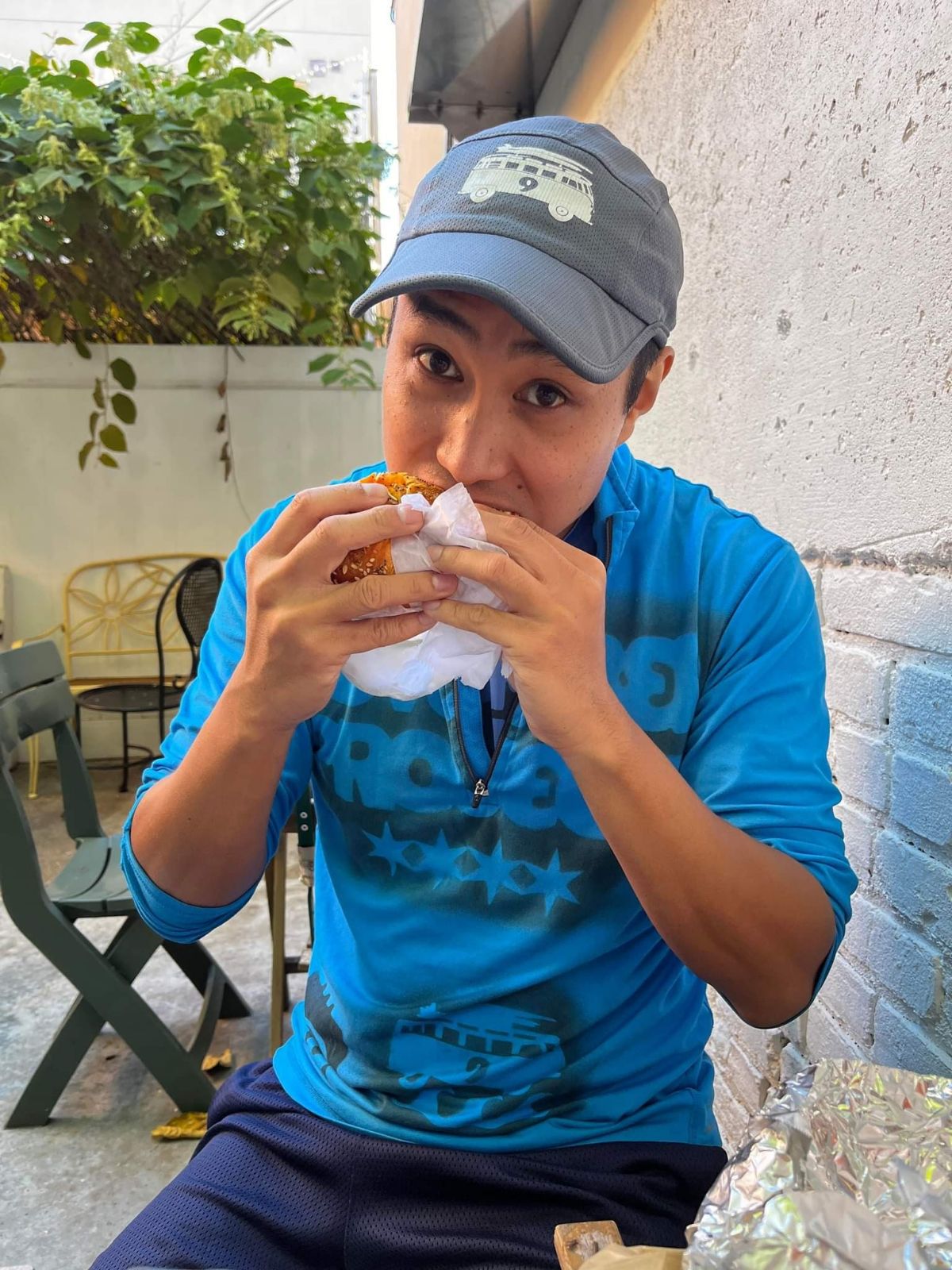
Did you have any apprehensions to lead this group? Did you experience imposter syndrome when you were asked to lead? What advice would you give to another Asian and/or Pacific Islander person who is nervous about leading a group (at November Project or anywhere else) or coming to November Project?
When the call came out that NP-Chicago needed new Co-leaders, a handful of people approached to say they were nominating me. If anything, THIS was the moment when I had some apprehension: Were people nominating me because there was this guilt or need to nominate a person of color given the community climate? And if people were nominating me to be an “Asian-American” Co-leader, what does that even mean? Would I have to be this vanguard or an Asian-American movement? Because if I was, frankly, I might not be the best candidate because I really do not know as much as I should about Filipino history, Filipino-American history, much less the history and trials of tribulations of my other Asian, Native Hawaiian, or Pacific Islander brethren. Would other members of the Asian-American community expect me to act a certain way, represent certain viewpoints, and have to pass a test on being a “real Asian”.
What I’m realizing is that my past, my experiences, my values, are an amalgam of influences that come from a number of different sources. Being Filipino-American is a large part of my person, but also growing up in Chicago, traveling and living in different places, the books I read, the shows I watch, and all the people I’ve talked to and learned from.
It might not look like a “typical” Asian-American experience, whatever the hell “typical” means.
But my life is real, it is legitimate, and it is my truth, whatever anyone says or whatever my imagination and my fears take me.
And thus, no matter what anyone says, my experience IS an authentic Asian experience. It is the experience of a first generation Filipino-American who was raised by hardworking immigrant parents working multiple jobs trying to make ends meet in a small Chicago apartment eating spam or corned beef with rice and eggs for multiple meals to make the budget stretch out until the next paycheck. Or having other members of the Filipino community babysit me while my parents were out working, until my grandparents started coming to the US to help raise me in a multigenerational household like many other immigrant families I have come to know. Or how you were sent to school once with Filipino food as your baon (ba-on, lunch) but after an embarrassing afternoon had to tell your grandparents to make bologna sandwiches from now on.
I hope other AANHPI members can read this and find comfort that we have had similar paths, but also feel comfortable in reaching out if they have had different experiences. Because whether the experience is the same or different from mine or others, it is real, and your truth is as legitimate as everyone else’s, and you should never have to make any apologies.
How do you celebrate Asian American, Native Hawaiian, and Pacific Islander Heritage Month? How can others celebrate you or celebrate with you this day? How can we celebrate you all year long?
This month had never been a big deal for me. Most of my life I can probably count on half a hand the amount of years I actually paid attention to this date.
At one point I was actually very turned off to the designation of “Asian-American”. Ten years ago, I had shown interest in participating in an Asian-American networking group. I attended a couple of events, and had shown interest in joining some committees, but had noticed that the group were mostly individuals from East Asia. In fact, from my point of view, if you were not Chinese or Korean, don’t bother participating. Feeling like an imposter, I never did end up doing more with the group.
To my knowledge after looking into the group again a couple months ago, I was very happy to see Filipinos in prominent positions in this group. I have also come around to the designation, and now would happily celebrate the month moving forward with my AANHPI brethren.
Alexa and I taking leadership positions in November Project Chicago a month before AANHPI month was very fortunate timing in some ways, although happening during the week of NP CHI’s birthday month, plus the fact the two of us are still getting our feet wet, made it a little harder for us to lean into a more prolonged month long celebration.
That said, we ran a successful Filipino themed workout where we introduced some aspects of our culture that made us proud. In general, all I ask of others in our community is to be open minded: Join us if we have a social centered around Filipino food. Ask us questions about our culture and upbringing if you are curious. Join us if we happen to go see an Asian-American comedian, movie, or show. Again, it doesn’t have to be these grand gestures, but having a genuine curiosity of how others live.
What else do you want people reading this to know?
This survey took me awhile finish. It brought up several moments of deep reflection in an effort to give honest answers to the questions placed before me. It is never easy to reflect upon your identity, but it is absolutely necessary not only to be an effective leader but an effective person in the long run. Being Asian-American and Filipino-American is an integral part of my identity. It does not define me completely, but it is an undeniable influence that I am ultimately proud of.