

November Project is a community where everyone is invited to #JustShowUp and Come As You Are – something we value so much, it’s our first Community Agreement. Today, on International Transgender Day of Visibility, we are excited to celebrate some of our transgender Co-leaders and community members.
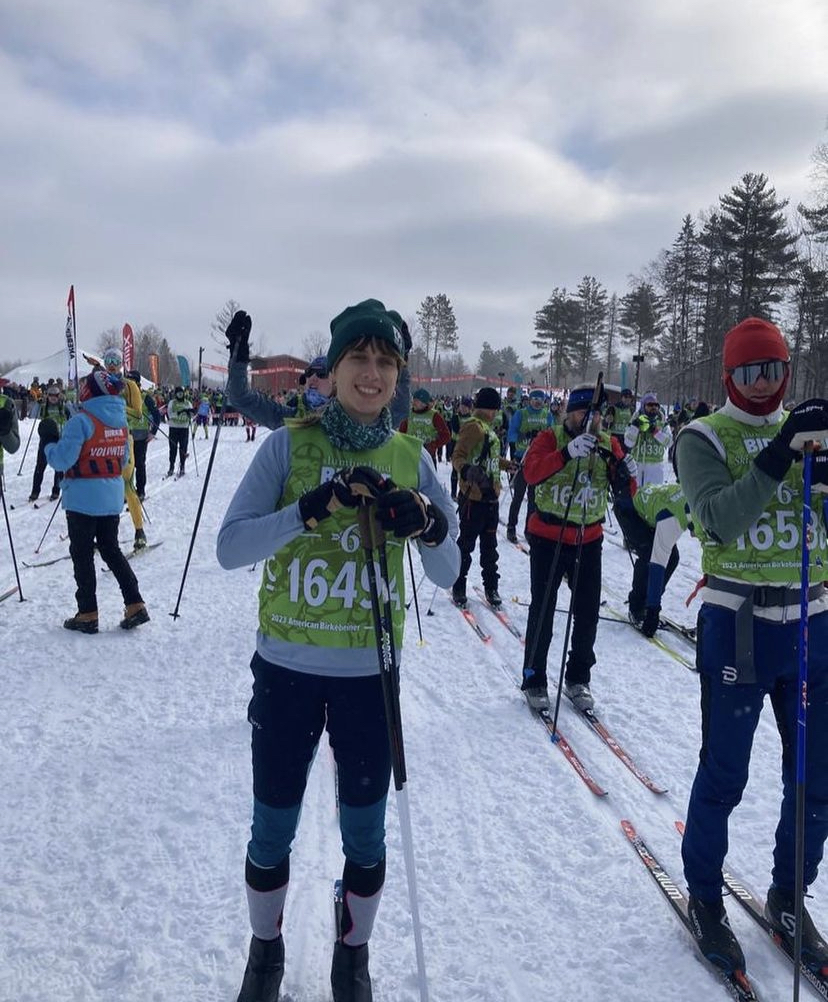
Here, we hear from Emma (she/her) – a community member who not only decides to #JustShowUp at NP Madison, but also helps to run their social media and organize community events, including an annual trail race/camping gathering.
- Name
Emma Cameron
- Pronouns
she/her
- NP Home City
Madison, WI
- Have you #traverbaled to any other NP cities?
From memory, at least Seattle, Austin, Chicago, Minneapolis (for a whole year), Boston, Oakland, and Los Angeles. Sadly I still haven’t made it to Milwaukee!
- What words do you use to describe your full identity/all your identities?
I would say “queer trans woman” is the best encapsulation of myself. I sometimes also like the word transsexual, but only with other trans people. Cis people, definitely do not use this word for any trans people you know unless they say that is okay!
- Who are some of the transgender athletes in the world of running/sport that you look up to?
This is such a great question! I have admired Schuyler Bailar and Chris Mosier’s informative presence on Instagram for a while. I also admire the work that Nikki Hiltz is doing for non-binary runners and other athletes. Unfortunately, the list of transfeminine athletes (especially runners) is short, and I think it is telling that certain (read: white) non-binary and trans male athletes tend to receive the majority of attention. Amelia Gapin is someone I looked up to years ago, but she has taken a step away from activism and social media recently.
- When did you first #JustShowUp to NP? How did you come across NP? What is it that you were looking for in a fitness group? How did NP provide that? What was an “extra” that NP has that you found value in?
My first NP workout was on Wednesday, September 23, 2015. I came across the workouts after some of my fellow grad students in geoscience told me about something they called “Project November” that was close to campus on Bascom Hill, and invited me to join their small group of attendees. At the time, I was not entirely sure myself what I was looking for in a fitness group or if I even wanted one. Over the years, the “extra” that NP provided was the locally-grounded, supportive community that was likely one of the largest factors keeping me in Wisconsin for as long as I have lived here. The group was and still is comprised of some of the most compassionate, friendly folks around and was the first majority-cis space that I felt comfortable coming out to. I think this sense of community and support came from, at first, coffee after the workouts, and later, social events, taking new friendships outside of NP, and beginning to organize activities within the community myself.
- What apprehensions did you have as you considered coming for the first time? What was your first impression? Why did you keep showing up?
I was really uncertain about the bounce, and how difficult the workout would be. I wasn’t sure it would be approachable for me. I found that I was put off by the “white rowing bro” mentality that has since been spoken of at length in blogs, books, and other publications about NP. I really didn’t like how many sweaty hugs from shirtless guys there were, and how it felt like a requirement to accept them. It was also a fairly loud, boisterous environment that prized competition, speed, and at the time, a sense of machismo. I certainly didn’t immediately feel inspired to come to coffee after the workouts right away, but once I was encouraged by a few folks and co-leaders enough times, going to coffee was the shift that ultimately led me to long-term attendance.
- What does it mean to you to be transgender? What does it mean to your community? What does it mean to our global community?
Being trans, to me, is about joy. So much of the discourse surrounding our community, especially today, centers on our collective dysphoria, violence, and sadness. Coming to terms with myself, I liked to center the idea of euphoria rather than dysphoria. Being trans, being in my body, and moving in my body are all enmeshed together. Being a trans athlete, and especially a trans runner, brings me incredible joy and is something I greatly cherish. To the local and global NP community, I think it is important to continue to show examples of how trans people can live, thrive, and move in the world. I hope that by being who I am, I make it possible for other queer and trans youth and adults alike to enter joyous movement with their bodies in the ways that suit them best, even amidst continued attacks on our community and our participation in sports.
- How has your NP community made you feel affirmed in your identity? What more could they do to make you feel affirmed in your identity?
The biggest thing anyone can offer, at the minimum, is respect. Sometimes it is jarring to experience people who cannot even offer that to trans people, and look to ‘other’ us, to dehumanize and reduce us to “ideology” rather than view us as living, breathing humans. The NP community has offered that respect and so much more to me. I have found so much emotional, mental, and physical support through its constituent members. I don’t think there is much more concrete that could be done at this time other than continuing to meet every new member of the community where they are and offering them respect and support as they navigate their position in the fitness community and in their life.
- How does being trans influence your movement/running? Did you transition while you were coming to NP? If so, what was that like?
As I mentioned above, I think being trans is something that brings more joy to my movement and running. Before coming out to myself and others, I knew that something was missing in my experience of movement–I knew what it was, but it took far too long to admit it to myself. I did transition while coming to NP, and running and being in community with others through movement became absolutely essential to the way I lived my life in that process. As a trans person who pursued a medical transition, running was and is the best way for me to physically encounter my changing body in motion and reconcile that with my mind and my heart. Transitioning through my time in NP was, by and large, a good experience, and I relied a fair bit on the community as one of my rocks of support through the process. I will forever be grateful to everyone within NP Madison and Minneapolis alike for their friendship, camaraderie, support, and respect during that time.
- Do you have any advice for cisgender NP members on creating a welcoming environment for transgender NP members? What is something that an ally has done to make you feel included and welcomed that has stuck with you?
To start, it is true that there are simply more cis people than trans people in the world, so I don’t think it’s necessarily a problem that trans people (that I’m aware of) might be few and far between within NP communities. That said, with all of the attacks centering trans people lately in this country and especially our ability to play sports, it might be worth specifically inviting trans people to attend workouts. Usually, this could be more about signals and slight changes to language rather than anything else concrete. Inviting people to share their pronouns where feasible, hosting events where there are gender-neutral bathrooms, donating to local organizations that support trans people, etc. These are several options to start.
- The state of the country is…oof when it comes to legislation on transgender citizens. How can cisgender allies show up for you outside of workouts to make you feel supported and safe?
This question is perhaps the most important to me as a trans athlete, race director, and community organizer alike. The discourse surrounding trans people in this country is absolutely vile at the moment. As you would when encountering racist rhetoric, attitudes, or actions, I would encourage you to speak out against transphobia when you see, hear, or witness it. Even small details that you might consider insignificant add to the overall ways that cis people view and understand the trans community. You can also continue to educate yourself on what it means to be a trans person. Understand that just as we live in a white supremacist world where we all have to navigate our own internalized racism, we also all live in a cissexist world where being cisgender is seen as the ‘default’ or norm. Reckon with your honest reaction to the way trans people express ourselves, the ways we move through the world, and how and why we might pursue medical transition. Take a strong stance against transphobic public figures and TERFs (trans-exclusionary radical feminists).
- How do you celebrate International Transgender Day of Visibility? How can others celebrate you or celebrate with you this day? How can we celebrate you all year long?
Well, I celebrate in part by agreeing to participate in this blog piece! As each TDOV passes, I like to spend the day engaging with other trans people in community events, like at the women-owned Giant Jones Brewery TDOV pop-up event in Madison. I think about what visibility means to me and other trans people, and how it is both a blessing and a curse. Increased visibility leads to increased attention, which as we have seen with recent legislation targeting trans people, is not always helpful. You can celebrate TDOV by making concrete steps to educate yourself, especially as a cis person. Send money to trans-led organizations working for trans people, or literally just give money to a trans person in your life. In doing this work, center trans people of color–especially Black trans women, wherever possible.
Share via socials:

